
HR rarely becomes complicated all at once. It usually happens slowly.
A business starts with a small team, a shared spreadsheet and a few leave requests over email. Then the company grows. Attendance moves to another system. Payroll sits with finance. Employee documents are stored in folders. Appraisals happen in separate sheets. Recruitment has its own tracker. Somewhere along the way, HR starts spending more time chasing information than actually managing people.
That is exactly where the right HR technology begins to make a real difference.
For growing organisations looking for the best HR management software in India, the question is no longer simply, “Can this software store employee data?” The better question is, “Can it connect the everyday HR processes that currently happen in different places?”
Because good HR software should not create another layer of work. It should remove one.
When HR Starts Running on Too Many Tabs
Think about a fairly normal Monday morning.
One employee has forgotten to regularise attendance. Another is asking about leave balance. A new hire needs onboarding documents. Finance wants payroll inputs before noon. A manager is waiting for appraisal data. HR is also trying to schedule interviews for three open positions.
None of these tasks is unusual.
The problem begins when every task lives in a different system.
A spreadsheet tracks attendance. Another file stores salary details. Leave approvals sit in email. Candidate information is spread across job portals. Performance reviews are updated manually. Employee documents are saved in folders that only one or two people know how to navigate.
The result is not necessarily chaos. More often, it is something worse: constant administrative friction.
What Does HR Management Software Actually Change?
A modern HRMS brings core workforce processes into a more connected environment.
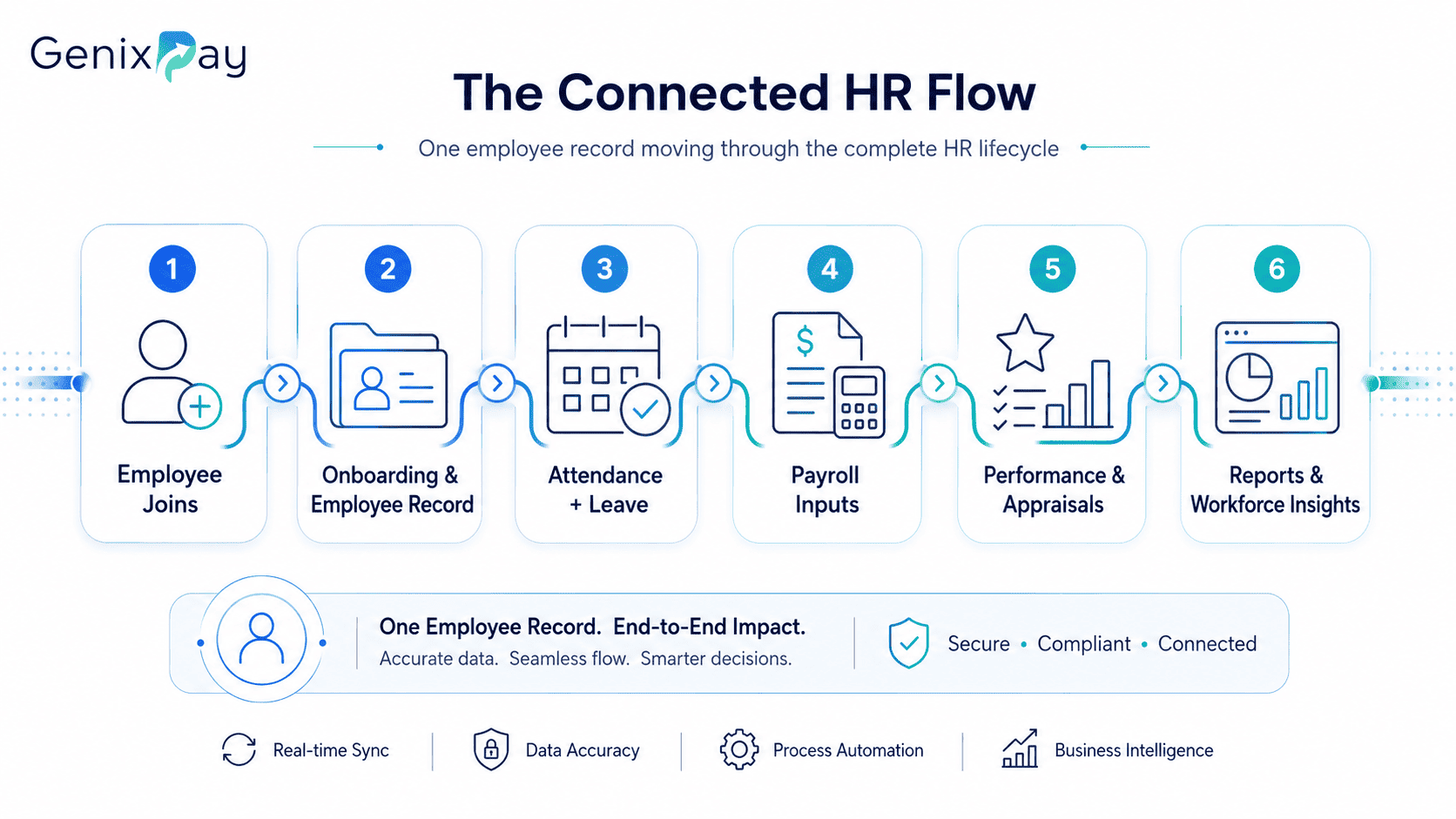
Instead of treating attendance, payroll, onboarding and performance as separate functions, the system allows information to move between them.
That matters because most HR tasks are connected in real life.
When these processes are disconnected, HR repeatedly enters, checks and transfers the same information. When they are connected, much of that repetitive work can be reduced.
Before HRMS vs With an Integrated HRMS
| HR Activity | Manual or Disconnected Process | Integrated HRMS Approach |
|---|---|---|
| Attendance | Separate sheets or standalone records | Central attendance visibility |
| Leave | Emails and manual approvals | Structured request and approval workflow |
| Onboarding | Documents collected across multiple channels | Centralised employee onboarding |
| Payroll Inputs | Attendance and salary data compiled manually | Connected workforce and payroll data |
| Employee Records | Files spread across folders | Unified employee database |
| Performance | Separate appraisal sheets | Structured goals and review records |
| Reporting | Reports prepared manually | Centralised workforce insights |
The biggest difference is not just automation. It is continuity.
Information entered once can support several connected HR processes.
1. Onboarding Becomes a Process, not a Paper Chase
The first few days of employment usually involve a surprising amount of administration.
Personal details. Documents. Department allocation. Reporting manager. Salary information. Policies. Account access. Employee IDs.
When onboarding is handled manually, HR spends time following up for missing information and transferring details between files and departments.
Employee onboarding software creates a structured digital flow instead.
New employee information can be captured systematically, documents can be organised centrally, and the employee record can become the starting point for attendance, payroll and performance management.
For the employee, the experience feels more organised.
For HR, it reduces repetitive data entry from the very beginning.
2. Attendance Stops Being a Month-End Surprise
Attendance looks like a simple function until payroll week arrives.
Missing punches, leave adjustments, late entries, shift records and attendance regularisation can quickly turn into dozens of small corrections.
A connected attendance system gives HR and managers greater visibility throughout the month rather than forcing them to resolve everything at the end.
When combined with biometric attendance software or other digital attendance inputs, records can flow into the wider HR system instead of remaining isolated.
This is one reason businesses searching for the best attendance management software should look beyond basic punch-in and punch-out functionality. Attendance becomes far more useful when it is connected to leave, employee records and payroll.
3. Payroll Gets Cleaner When HR Data Is Already Connected
Payroll often becomes difficult because the calculation itself is only one part of the job.
Before salary processing begins, someone has to collect attendance information, leave records, salary structures, deductions, advances and other employee inputs.
If these sit in different systems, payroll becomes a monthly reconciliation exercise.
An integrated HR and payroll software setup reduces that fragmentation.
Attendance and leave information can feed the payroll workflow, while salary records remain connected to the employee profile. HR and finance teams spend less time moving information from one file to another and more time reviewing the final data.
That does not remove the need for checks and approvals.
It simply gives those checks a much cleaner starting point.
We cover this in more detail in Payroll Shouldn’t Take Over Your Month: How Automation Makes Salary Processing Simpler.
4. Recruitment Can Connect Directly to Employee Management
Hiring is another area where businesses often use one tool to find candidates and another to manage employees.
The break between the two creates unnecessary duplication.
A modern HRMS can help create a smoother flow from recruitment to onboarding. Candidate details collected during the hiring process can become part of the employee journey after selection.
For companies evaluating top hiring software, this connection is worth considering.
Recruitment technology becomes much more valuable when it does not stop the moment a candidate accepts the offer.
5. Appraisals Become Easier to Structure
Performance reviews often become inconsistent when every manager uses a different spreadsheet or format.
One team may track goals monthly. Another may review employees only once a year. A third might rely almost entirely on manager comments.
HR software helps create a common structure.
Goals, review cycles, employee information and performance records can be organised in one place. Managers gain a clearer view of previous reviews, while HR can monitor appraisal activity across teams.
The objective is not to turn performance management into a robotic scorecard.
It is to give conversations better context.
What Should You Look for in the Best HR Management Software in India?
There is no useful answer based purely on the number of features.
A system with fifty modules is not automatically better than one with fifteen.
The better approach is to evaluate how well the platform fits your actual HR workflows.
Look for these fundamentals:
The best HR management software in India should ideally reduce the number of disconnected tools your team needs to manage.
That is a more practical measure of value than simply comparing feature lists.
A Good HRMS Should Help the Whole Organisation
HR technology is often presented as something built only for HR departments.
In reality, its impact extends much further.
Employees get easier access to their information and requests. Managers can see attendance, leave and performance details without repeatedly asking HR. Finance receives more organised payroll inputs. Leadership gets better workforce visibility.
That is why HRMS increasingly overlaps with the idea of workforce management.
For organisations trying to identify the best workforce management company or HR platform, the focus should be on how well the system connects employees, managers, HR and business operations.
Where Genixpay Fits In
Genixpay approaches HR management as part of a broader digital business ecosystem.
Its HRMS capabilities are designed to bring recruitment, employee onboarding, attendance, leave, payroll, performance management and reporting into a more centralised workflow.
For growing businesses, the benefit is straightforward: fewer disconnected processes and better visibility across the employee lifecycle.
The goal is not to replace the human side of HR.
It is to remove enough administrative friction so HR teams have more time for it.
The Takeaway
HR teams should not have to spend every month rebuilding information they already collected.
When onboarding, attendance, payroll and appraisals work as connected processes, HR becomes easier to manage and easier to scale.
The right software does not make people management impersonal.
Used well, it does the opposite.
It takes repetitive administration out of the way so HR teams can spend more time on the part of their job that actually requires people: conversations, development, culture and better workplace decisions.
“Still managing people across spreadsheets, emails and disconnected tools?”
Bring your HR processes together with Genixpay and build a simpler, more connected way to manage your workforce.